Discover how Wildebeest Brandewyn brings South Africa’s rich brandy-making heritage to a new generation, taking local spirit tradition onto the world stage. It is part of a new chapter for South African spirits.
There is a tendency to talk about African spirits as though their arrival on the international stage is still something that needs to happen. But in South Africa, the foundations have been there for generations.
South Africa has spent generations perfecting the art of brandy, with vineyards, copper stills, oak and time shaping a spirit that is deeply rooted in place. Now, that heritage is entering a new era, one where tradition meets a fresh sense of identity and a new generation of drinkers is discovering what South African spirits can be.
At the heart of that shift is Wildebeest Brandewyn, a flagship brand owned and manufactured by Bundu Brands, taking a distinctly South African story beyond familiar borders and onto a much bigger stage.
For Bundu Brands, the opportunity is not simply to put another South African bottle on an international shelf. It is to take something recognisably local and give it the confidence, language and contemporary identity to travel. South African craftsmanship belongs on the world stage. And the story begins with the spirit itself.
Brandy Is One of South Africa’s Overlooked Craft Stories
Brandy has long occupied a distinctive place in South African drinking culture. South Africa has its own established brandy heritage and a story that deserves greater recognition both locally and internationally.
According to research documented by South African History Online, brandy has long formed part of South Africa’s cultural and social history. Its history in the country dates back to the early Cape colony: by 1672, brandy was being produced locally and was used as currency in bartering relations with the Khoikhoi.
Cape Brandy, in particular, is rooted in South Africa’s wine-growing regions and a production tradition built around pot-still distillation, local grapes and maturation in oak. Wildebeest Brandewyn explains that Cape Brandy is produced using grapes grown in South Africa’s Cape Wine Regions, is 100% double-pot-still distilled, and must be matured for a minimum of three years in oak casks of less than 340 litres, with the spirit produced, matured and bottled locally.
These details matter because premium spirits are ultimately built on things that cannot be hurried. Distillation determines the spirit’s foundations. Oak gives it another dimension. Time brings the two together.
Heritage Does Not Have to Look Old-fashioned
This is perhaps where Wildebeest Brandewyn’s positioning becomes particularly interesting.
Its identity is deliberately not built around nostalgia alone. Wildebeest draws on distinct South African references — the African plains, the idea of gathering, the braai, camaraderie and a sense of adventure — but expresses those references through a contemporary premium-spirit aesthetic.
Heritage is most powerful when it is treated as a foundation rather than a museum piece.
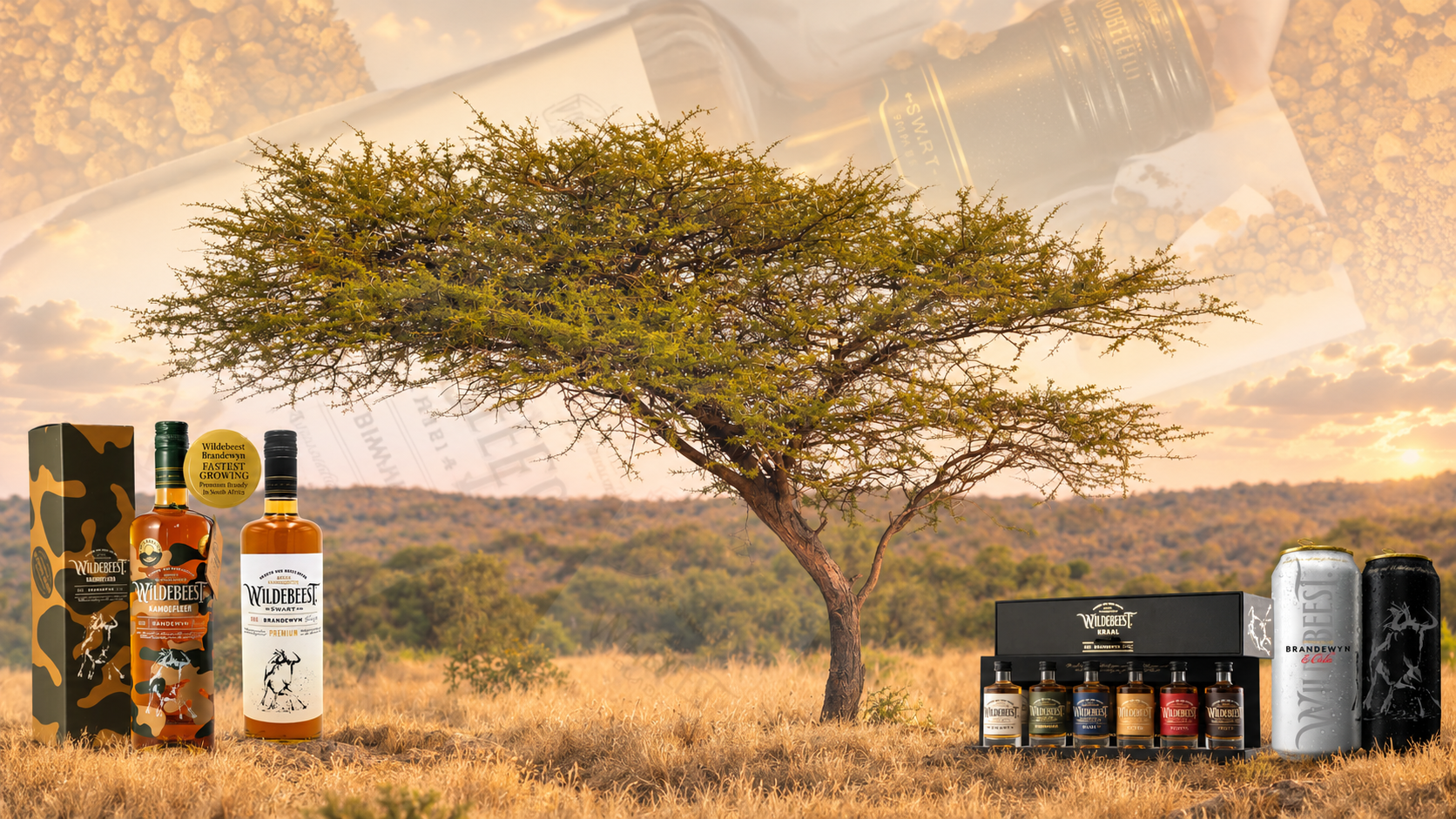
The Wildebeest Brandewyn portfolio illustrates that approach. Swart is positioned as a fuller, bold expression suited to mixing, while Kamoefleer takes a smoother, more refined route designed for drinking neat or over ice. The KRAAL tasting format, meanwhile, turns the brand’s range into an exploration of different expressions rather than simply another bottle on the shelf.
For the traditional brandy drinker, there is familiarity. For the curious younger spirits consumer, there is discovery. For an international audience, there is a distinctly South African point of difference.
The Wildebeest is unmistakably African, but it is not a static symbol. It moves. It travels in herds. It is associated with distance, endurance and the vastness of the continent’s landscapes.
From Shelf Presence to Cultural Relevance
Wildebeest Brandewyn is no longer simply a proposition waiting to be discovered. The brand already has a growing retail presence in South Africa, including Norman Goodfellows, as well as major national retailers such as Checkers, TOPS at SPAR and Makro.
Bundu Brands’ own platform also reflects a portfolio that is expanding beyond a single traditional brand format, with ready-to-drink expressions alongside its bottled spirits. A bottle shared slowly over ice, a brandy and cola around a braai, a tasting experience with friends, or a ready-to-drink can for a more informal occasion can all belong to the same brand world.
The established retail footprint across Africa provides a foundation. Increasing consumer recognition nationally creates another. The next step is to introduce Wildebeest to international consumers, retailers, distributors and spirits partners who are increasingly interested in distinctive products with a genuine sense of place.
The Export Story Starts with Authenticity
International expansion can sometimes flatten a brand. A product crosses a border and, in trying to appeal to everyone, loses the very characteristics that made it interesting in the first place. South African spirits have an opportunity to take the opposite approach.
The strongest export story may be the most authentic one. Its advantage is precisely that it comes from South Africa, from a country with an established distilling tradition, a strong wine culture, extraordinary landscapes and a social culture in which sharing a drink is often inseparable from sharing time. This sense of place gives the liquid context.
It also gives retailers and international partners something increasingly valuable: a story consumers can remember. The premium spirits market is crowded, with brands competing not only on the quality of the liquid but also on provenance, craftsmanship, ingredients, packaging and brand identity.
Industry analysis from Park Street notes that, in such a saturated and fragmented category, successful spirits brands need more than a good product; they need clear positioning and a compelling story that gives consumers a reason to remember and share the brand.
Wildebeest’s proposition is ultimately about bringing three things together: the credibility of South African craftsmanship, the exceptional quality of the liquid, and the energy of a modern African brand.
A Different Definition of Going Global
Going global does not mean leaving behind what makes a brand South African. For Wildebeest Brandewyn, it means taking that South African identity, craftsmanship and sense of place confidently to new audiences around the world.
The brand’s ambition is not simply to export a liquid. It is to export a perspective on what a premium African spirit can look and feel like: sophisticated without losing its personality, rooted in tradition without being trapped by it, and proudly local while remaining relevant to consumers far beyond its place of origin.
For Bundu Brands, that makes the road ahead bigger than distribution. It is about creating brands that earn a place in people’s rituals: the bottle they recognise, the drink they ask for, and the spirit they introduce to someone else. That is how a regional product begins to become a global brand.
South Africa already has the vineyards, the distilling knowledge, the oak, the history and the craftsmanship. The next question is whether the world gets to experience more of it. With Wildebeest Brandewyn, the answer is beginning to take shape.
Born in South Africa. Rooted in heritage. Crafted for today. Ready for the world.