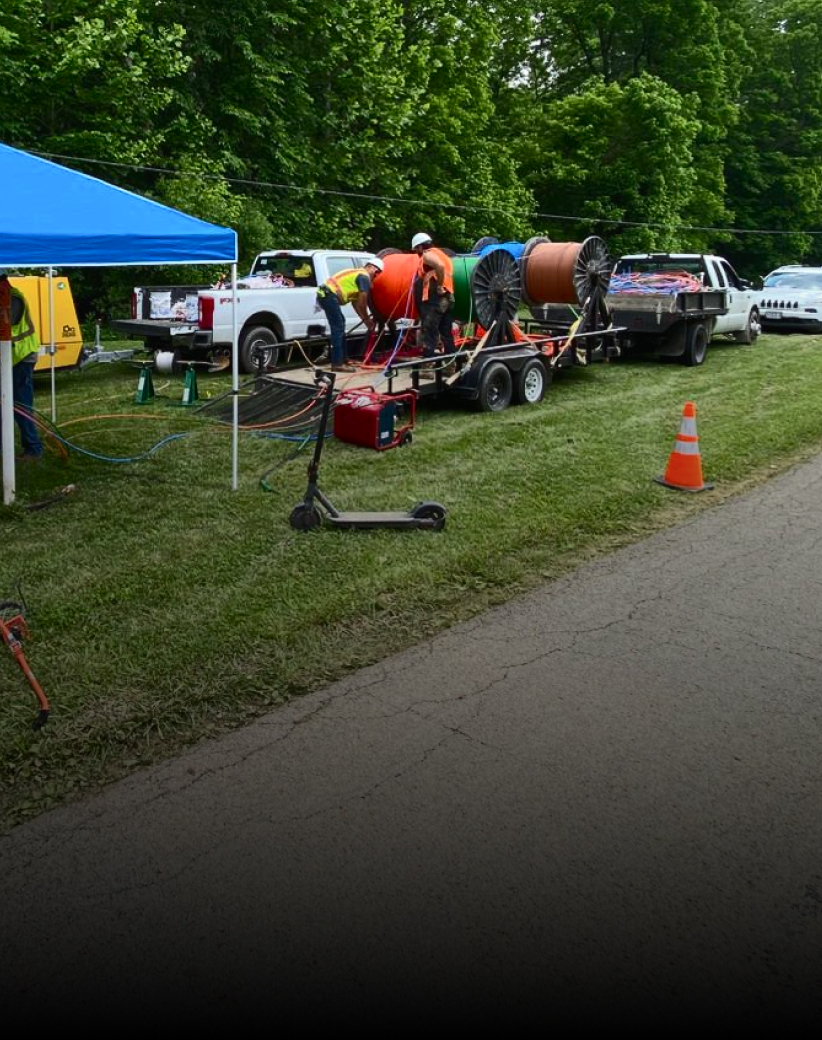
Reliable connectivity does not begin with a fibre cable. It begins with a bold vision, a definite plan and the discipline to execute relentlessly.
South Africa’s digital economy increasingly depends on infrastructure that most people never see. Fibre networks underpin remote work, digital commerce, education, cloud services, communication and an expanding ecosystem of businesses and public services. As demand for high-speed connectivity grows, however, the real infrastructure challenge is no longer simply getting fibre into the ground. It is building networks that can perform reliably, scale intelligently and remain resilient long after the infrastructure teams have left.
South Africa already has more than 200,000 kilometres of terrestrial fibre routes, while demand for fibre connectivity continues to accelerate. According to Opensignal’s South Africa Fixed Broadband Experience report (April 2026), citing data from the Independent Communications Authority of South Africa (ICASA), FTTH/B subscriptions increased by 22% in 2025 to reach 3.01 million.
The next phase of connectivity will therefore be defined not only by expansion but also by the quality, discipline and accountability behind that expansion. For VCOM, that distinction is fundamental.
The Infrastructure Behind the Connection
A successful fibre deployment depends on a sequence of interdependent planning and design decisions. The FTTH Council Europe’s FTTH Handbook identifies strategic network planning, high-level network design and detailed network design as successive stages of deployment: determining where and when to roll out the network, establishing network architecture and routes, and ultimately producing the detailed plans required for construction.
Civil works determine how effectively it can be deployed. Micro-trenching and conventional trenching can accelerate rollout while managing disruption. Fibre installation requires technical precision. Splicing and testing determine whether the network performs to specification. Reinstatement protects the surrounding environment and public realm. Maintenance ultimately determines whether that performance can be sustained. Every stage matters because weaknesses compound.
As recognised in ITU-T recommendations, fibre splices are critical points in an optical network because they can strongly affect link quality and lifetime; installation quality likewise has a direct bearing on cable integrity and attenuation. Insufficient testing can allow defects to remain undetected. And a network without disciplined maintenance can quickly become a liability rather than an asset. This is why fibre delivery is better understood as an end-to-end infrastructure discipline, rather than a construction exercise.
Planning Is Where Performance Begins
Fibre-network construction is preceded by detailed planning: route surveys and design, wayleaves and permits, technical requirements, stakeholder coordination, construction sequencing, materials planning and quality controls. Industry guidance from the Fiber Optic Association reflects this structured approach, where the design and planning phase establishes the requirements for successful delivery.
For VCOM, this reflects a broader philosophy: vision must be converted into definite plans. The objective is not simply to deploy kilometres of fibre. It is to create infrastructure capable of supporting communities, businesses and network operators over the long term. That requires clarity around what is being built, why it is being built and what standards will define success.
Precision Matters Below the Surface
NTIA also discusses approaches designed to reduce the disruption associated with broadband construction. Its guidance says that avoiding repeated excavation can reduce deployment costs and lessen disturbances to traffic and the environment. VCOM’s model incorporates these different approaches as part of a broader turnkey capability spanning planning, deployment and maintenance. But speed cannot come at the expense of quality.
Once fibre is installed, splicing and testing become critical control points. Optical performance must be verified; connections must be executed precisely and faults identified before infrastructure is handed over. The principle is straightforward: network reliability is engineered long before customers experience it.
Reinstatement Is Part of the Job
One of the least visible aspects of fibre construction is also one of the clearest measures of professional delivery. Roads, pavements, verges and other surfaces disrupted during construction must be reinstated properly. The objective is not simply to complete the network; it is to leave the surrounding environment safe, functional and fit for purpose.
This mindset speaks to a broader principle of infrastructure delivery: completion is not the same as success. Success means more than completing the physical installation. As the World Bank’s Environmental and Social Framework emphasises, effective infrastructure delivery requires attention to environmental and social risks, community health and safety, stakeholder engagement and accountability throughout the project lifecycle. For fibre construction, this means meeting technical requirements, protecting communities, controlling disruption and delivering an asset that performs as intended.
Reliability Is Built After the Build
Perhaps the most important part of the fibre lifecycle begins once fibre installation is complete. Networks require monitoring, maintenance and rapid response to faults. As connectivity becomes more deeply embedded in economic and social activity, downtime carries consequences far beyond inconvenience. Businesses depend on connectivity for continuity. Students depend on it for access to education. Communities depend on it for essential services and economic participation.
That makes maintenance and operational responsibility a top priority.
Building More Than Fibre
VCOM’s proposition ultimately rests on a deceptively simple idea: to build, to connect and to maintain. Its model combines national reach, turnkey capability, technical expertise and a community-first approach that includes local employment, skills development and stakeholder engagement. The company reports more than 1,000 kilometres of fibre deployed, more than 100 projects delivered and operations across nine provinces.
These capabilities point to a larger lesson for Africa’s connectivity future. The winners in digital infrastructure will not necessarily be those that build fastest. They will be those that can consistently translate vision into execution, maintain quality at scale and remain accountable throughout the infrastructure lifecycle.
Because connectivity is only as strong as the infrastructure behind it. And infrastructure that is built with vision, executed with discipline and maintained with accountability does more than connect networks. It connects people to opportunity.